
Cyber Hull – Malicious URL Detection System
Deterministic Geometric Threat Isolation for Zero-Day Phishing Protection.
Cyber Hull is a deterministic, resource-efficient malicious URL detection framework based on Convex Hull computational geometry. Unlike probabilistic ML/DL approaches, it constructs mathematically provable spatial boundaries ("Vaults") across three orthogonal feature domains: Structural Entropy, Semantic Keyword Distribution, and Hyperlink Graph Topography. With 92% detection accuracy, sub-millisecond inference, and CPU-only deployment, Cyber Hull delivers explainable, lightweight, and deterministic cybersecurity for modern edge environments.

92%
Detection Accuracy
0.84 ms
Inference Latency
38 MB
Memory Usage
9%
CPU Utilization
Dual-Phase Geometric Detection Architecture
Cyber Hull operates in two phases: Offline geometric boundary generation (training) and lightweight real-time edge inference (point-in-polyhedron verification).

Phase I: Feature Extraction & Vault Generation
Parse 91-dimensional features → Probabilistic variance matching → 46 optimized Vaults (QuickHull, O(n log n))
Phase II: Real-Time Edge Inference
Intercept request → Extract features → Point-in-polyhedron test across all Vaults (< 1 ms, CPU only)
Phase III: Multi-Vault Intersection Verification
Payload must pass ALL Vaults. If any vault boundary is breached → Malicious.
The Cyber Hull Advantage
Multi-Vault Geometric Verification
3 independent Vaults (Entropy, Semantic, Hyperlink) create overlapping defense layers. Even sophisticated APTs cannot pass all three simultaneously.
Structural Entropy Vault
Analyzes HTML content randomness. Legitimate sites have consistent entropy; phishing pages show extreme distortion (sparse or heavily obfuscated).
Semantic Keyword Vault
Analyzes TF-IDF distributions. Legitimate sites balanced; phishing pages dominated by urgency tokens ("login", "secure", "bank").
Hyperlink Graph Vault
Analyzes internal/external link topology. Legitimate sites have complex interconnections; phishing pages are sparse single-node constructs.
Mathematical Explainability
Not a black box. Every decision is provable: point-in-polyhedron verification with mathematically defined spatial boundaries.
CPU-Only Edge Deployment
0.84ms inference, 38MB memory, 9% CPU. Deployable on routers, IoT gateways, and hardware firewalls without GPU acceleration.
Core Technologies
Computes minimal convex hull perimeters around legitimate traffic points in each Vault using the QuickHull algorithm.
Key Features
- SciPy Spatial library implementation
- 91-dimensional feature parsing
- Probabilistic variance matching for feature selection
- 46 optimized geometric Vaults generated
Specifications
Training Complexity
O(n log n)
Vaults Generated
46
Deterministic Geometric Threat Isolation Engine
Cyber Hull transforms cybersecurity from reactive probabilistic prediction to deterministic geometric verification.
Vault 1: Structural Entropy
Analyzes HTML content randomness using Shannon entropy. Legitimate sites have consistent entropy; phishing pages show extreme distortion.
Vault 2: Semantic Keyword
Analyzes TF-IDF distributions. Legitimate sites balanced; phishing pages dominated by urgency tokens ("login", "secure", "bank").
Vault 3: Hyperlink Graph
Analyzes internal/external link topology. Legitimate sites have complex interconnections; phishing pages are sparse single-node constructs.
QuickHull Training Engine
Constructs minimal convex hull perimeters around legitimate traffic points. O(n log n) complexity. Generates 46 optimized Vaults.
Point-in-Polyhedron Inference
Sub-millisecond verification (< 1ms) on CPU. No GPU, no matrix multiplications, no neural predictions. Pure mathematical verification.
Mathematical Explainability
Technical Specifications
Applications & Target Audience
The Cyber Hull Advantage
Novel Technology & Features
Mathematically Deterministic Detection
Not probabilistic. Every decision is based on point-in-polyhedron verification with provable spatial boundaries.
Multi-Vault Cross-Verification
3 orthogonal Vaults create overlapping defense layers. A malicious payload must pass ALL three — mathematically impossible for sophisticated APTs.
CPU-Only Edge Deployment
0.84ms inference, 38MB memory, 9% CPU. Deployable on routers, IoT gateways, and hardware firewalls without GPU acceleration.
Visual Reference

Cyber Hull – Multi-Vault Geometric Architecture

Top 3 Interception Vaults – 3D Scatter Visualization
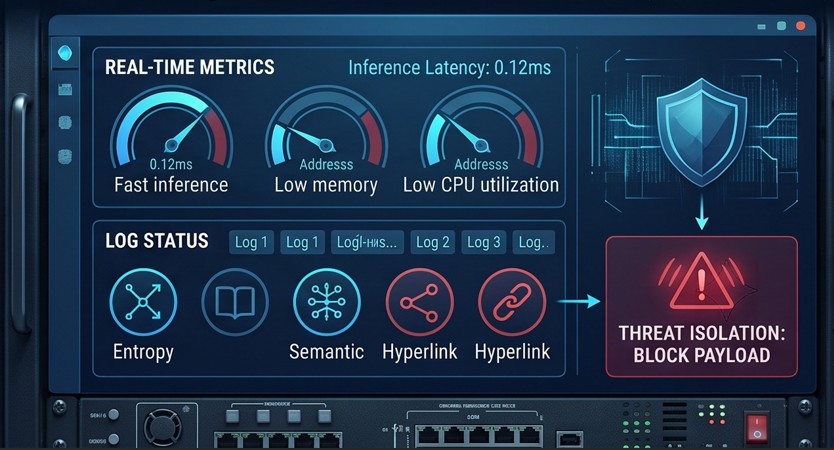
Feature Interception Hierarchy & Real-Time Dashboard